Welcome to the Computational and Analytical Molecular Evolution Lab at The Institute Formerly Known as CARB.

Exploring the Curious Disconnect in evolutionary theory

In "The Curious Disconnect", a blog launched in mid-March, 2010, Arlin Stoltzfus argues that there is a major "disconnect" between how we think about evolution, and how we we would think about it if we were freed from the historical baggage of Darwin's view and the subsequent "Modern Synthesis" (sometimes called "neo-Darwinism").  Installments of The Curious Disconnect will appear here and at at Larry Moran's Sandwalk site.  

Data Interop Hackathon held at NESCent

Evolutionary Data Hackathon: This spring NESCent organized an event that challenged a select group of programmers to improve interoperability of resources used in phylogenetics and evolutionary studies. The Evolutionary Database Interoperability Hackathon brought together programmers representing online data resources (e.g., MorphBank, TreeBase) with the developers of "glue" technologies that emerged from NESCent's Evolutionary Informatics working group. The EvoInfo working group (co-organized by Rutger Vos and Arlin Stoltzfus) focused on interoperability technologies, and generated

For more information, see the UMBI newsfeed article or go directly to the Hackathon Report.


Exploring the Curious Disconnect in evolutionary theory

In "The Curious Disconnect", a blog launched in mid-March, 2010, Arlin Stoltzfus argues that there is a major "disconnect" between how we think about evolution, and how we we would think about it if we were freed from the historical baggage of Darwin's view and the subsequent "Modern Synthesis" (sometimes called "neo-Darwinism").  Installments of The Curious Disconnect will appear here and at at Larry Moran's Sandwalk site.  

Mutation and evolutionary genetics

In this year of over-the-top homages to Darwin, one wonders why evolutionary biologists even bother coming to work every day, knowing that the last great insight into evolution happened 150 years ago. Actually, evolutionary thinking is undergoing a slow and uncertain revolution (if you can call it that) from Darwin's view of evolution as a process of shifting available variation to match an optimum, to a more open-ended process of mutational exploration of fitness landscapes. "Darwinists" of the past were so confident in the first view that they ridiculed the second one ("mutationism"). The first view takes abundant variation as a given and assumes that the character of variation does not influence the course of evolution (except by its complete absence). In the second view, mutation supplies initiative and direction.

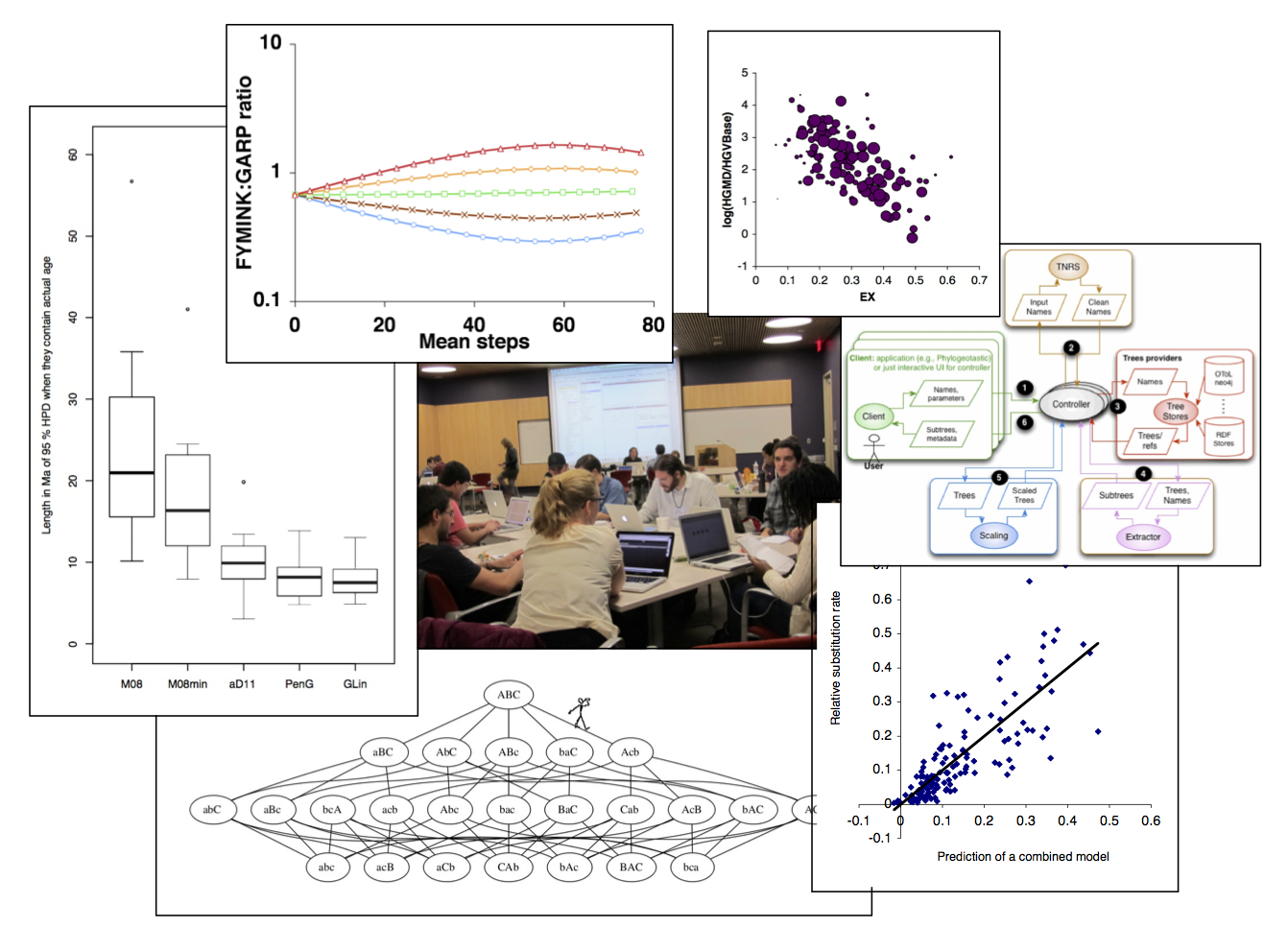
Indeed, biases in mutation (e.g., see bubble plot of mutation rates at right) bias the course of evolution, even adaptive evolution (see Rokyta, et al.), in a predictable manner. This causal influence raises many questions:
  • What is the population-genetic mechanism (see Yampolsky and Stoltzfus, 2001)?
  • How did neo-Darwinists overlook this mechanism, claiming instead that internal causes of direction are impossible (Stoltfus, 2006a)?
  • Can we tease apart mutational effects from fitness effects? (Yampolsky and Stoltzfus, 2005)
  • What kinds of mutation biases exist and what is their impact?
  • Can they cause long-term patterns or trends (Stoltzfus, 2006b)?
  • How often are mutational effects wrongly attributed to "function"?
  • What about developmental biases in phenotypic variation (Stoltzfus, 2006a)?

Our research in this vital and exciting area includes both theoretical modeling and data analysis. Ongoing work addresses the alleged adaptedness of the genetic code (Stoltzfus and Yampolsky, accepted), and the challenges for genomics (Stoltzfus, in prep).

CDAO published in Evolutionary Bioinformatics

CDAO: The Comparative Data Analysis Ontology (CDAO) project has been going on for about 18 months. Collaborators including Enrico Pontelli and Brandon Chisham of NMSU, and Julie Thompson and Francisco Prosdocimi of U. Strasbourg (France). The initial published description of CDAO has been accepted for publication in Evolutionary Bioinformatics.

Climbing Mount Probable: Mutation as a cause of non-randomness in evolution

Climbing Mount Probable: After what seems like years (2 years, to be exact-- but who's counting?), Climbing Mount Probable: Mutation as a cause of non-randomness in evolution is accepted for publication (in J. Heredity). Look here for a video link to appear soon.

Phyloinformatics VoCamp in Montpellier, France

A phyloinformatics "VoCamp" is taking place in coordination with the Biodiversity Information Standards (TDWG) meeting in Montpellier, France. The VoCamp takes place over 4 days from November 7 to 11. The plan for the meeting emerged from a group of individuals (Cellinese, Cranston, Lapp, MacKay, Pontelli, Stoltzfus) involved in previous phyloinformatics activities at the US National Evolutionary Synthesis Center, NESCent. The Phyloinformatics VoCamp is sponsored by NESCent (NSF# EF-0423641), with additional support from TDWG and LIRMM (University of Montpellier). More information is available at https://www.evoio.org/wiki/VoCamp1.

CDAO Developers meet in New Mexico

The Comparative Data Analysis Ontology (CDAO), is an OWL ontology representing knowledge in the area of comparative evolutionary analysis. It focuses on phylogenetic trees, OTUs, character data, and evolutionary transitions. CDAO developers recently met to develop the ontology further.

CDAO core developers met July 30 to August 1 in Las Cruces, NM, where they produced a preliminary mapping between CDAO and MAO (Multiple Alignment Ontology), worked out the representation of evolutionary changes ("transitions"), and hiked at Dripping Springs.


The meeting took place on the NMSU campus and was sponsored by the Computer Science Department.  Participants included Brandon Chisham (NMSU), Enrico Pontelli (NMSU), Julie D Thompson (U. Strasbourg, France), Francisco Prosdocimi (Universidade Católica de Brasília), Arlin Stoltzfus (NIST), and Son Tran (NMSU).

Syndicate content